

The mill that named the city.
The Edina story begins along Minnehaha Creek. A mill was erected at the creek in 1856. In 1869, a Scottish immigrant from Canada named Andrew Craik bought the operation and renamed it Edina Mills, after Edinburgh. That mill gave the area its name. By 1888, after years of being part of Richfield Township, Edina officially incorporated, one of the first independent suburbs of Minneapolis.
There is almost nothing left of the original mill, but the creek that powered it still runs through the city, and the homes along that creek corridor remain some of the most consistent waterproofing calls our crew runs in Edina.
Three settlements that became one city.
Before incorporation, Edina was three distinct settlements. Waterville Mills grew around Craik's mill on the creek. The Cahill Settlement, on the western side, was founded in the 1850s by Irish immigrants who had come to Minnesota during the Great Famine; the Cahill post office operated from 1894 to 1902. The third group, mostly Protestants from New England and Germany, settled around where Minnehaha Creek crosses 50th Street, the area that would much later become the Country Club District.
Each of those settlements seeded a separate neighborhood of foundations. Cahill homes from the 1880s and 1890s are fieldstone and limestone. The Waterville cluster around the creek mixed in early brick by the 1900s. The 50th-and-France area sat mostly empty until the 1920s and was developed all at once, as a planned community.
Minnehaha Creek and the till underneath.
Edina sits on glacial till, the mixed clay, silt, sand, and gravel left by the retreating Wisconsin glacier. Till is structurally stable but unforgiving for water management. The clay content holds water against foundations. The embedded sand and gravel pockets transmit it unpredictably. The clay-bowl effect, where backfilled soil around a foundation traps water against the wall, is at its strongest in profiles like this.
Minnehaha Creek runs the length of the city. Properties along the creek corridor, and there are many, because Edina was deliberately developed around the water, sit on alluvial deposits with a higher water table than the rest of the city. In wet springs the creek can rise enough to back-pressure the soil for blocks around it.
The Country Club District.
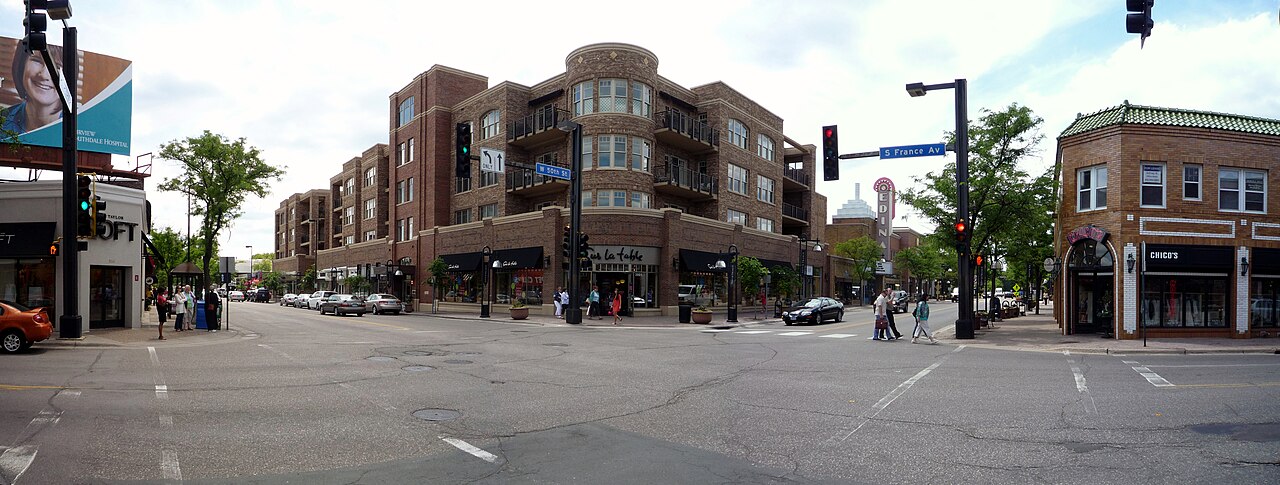
Beginning in 1924, the area near 50th and France was developed as the Country Club District, a planned residential community with covenants on lot size, setbacks, and architectural style. The homes are Tudor revivals, Colonial revivals, English cottage styles, and substantial brick four-squares, built mostly between 1924 and 1940. The foundations are early concrete block and, in the higher-end homes, poured concrete from the period when the technology was still new.
These are the most architecturally protected homes in Edina, and the most common challenge with them is that everything that has been done to keep them looking original has made the water problem worse. Finished basements installed in the 1980s. Sealed-in masonry. Sub-slab additions. By the time we're called, the wall is fine, the original drainage is exhausted, and the interior finishes are holding moisture in the structure instead of letting it dry out.
Post-war rambler infill.
The land that wasn't built on by 1940 mostly got built on between 1945 and 1965, small ranches and mid-century moderns on cinder block, with a few transitional poured-concrete homes by the late 50s. Edina, like every other Twin Cities suburb of its era, got tens of thousands of post-war ramblers. They are now sixty-plus years into a useful life that was designed assuming twenty, and they sit on the same till the Country Club homes do.
Why Edina basements leak today.
An Edina leak is usually one of three stories, and sometimes all three are on the same street:
- The Cahill / Waterville–era stone or early-block home (pre-1920). Lime mortar crumbling, perched water table in clay till, modern interior finishes trapping moisture.
- The Country Club District (1924–1940). Wall is usually fine. Decades of basement remodeling have sealed up natural ventilation. Original drain tile is silted. Hairline cracks at the cove joint under hydrostatic pressure.
- The post-war cinder-block rambler. Mortar joints failing, drain tile silted, grading shifted by every owner. Clay-bowl pressurization in every wet spring.
What this means for your home.
Edina is one of the most architecturally diverse cities we work in. The right system for a 1929 Tudor in the Country Club District is not the right system for a 1958 rambler near Cornelia or a 1905 stone home in Cahill. We diagnose first. We tell you what era your foundation is, what specifically is failing, and whether you need a full interior system or a smaller drainage correction.
For the older homes, the conversation is usually about a full interior drain tile system and disciplined humidity management to undo what the last forty years of remodeling did to a wall built to breathe. For the newer homes, the high-leverage opening move is usually a sump replacement, a downspout and grading correction, and a flush of the existing tile. Those are obvious contributors worth investigating first, addressing them, depending on your goals for the space, can save thousands and extend the time before a full system is necessary. We'll tell you which.