

A 2,000-square-foot roof sheds 1,250 gallons in a 1-inch rain.
That's the volume of water your gutters are responsible for routing away from the foundation in a routine spring storm. A heavy May thunderstorm dropping 3 inches in two hours triples that to roughly 3,750 gallons. If your downspouts dump that water inside the clay-bowl zone within three feet of the foundation, your basement is being flooded from above by physics you didn't notice.
Almost no Twin Cities home over 30 years old has its original grading intact. Decks get added, gardens get re-shaped, sod gets re-laid, A/C condensers get installed on top of drainage pathways. Each of those small changes pushes the slope toward the foundation rather than away from it. By the time the homeowner notices water in the basement, the surface water plan that came with the house is long gone.
The 2% slope rule and why it matters.
For many basements with light to moderate cove-joint seepage, fixing the grade alone fixes the leak. No concrete cutting needed.
International Residential Code R401.3 requires that finished grade fall a minimum of 6 inches over the first 10 feet from the foundation, a 2% slope. That's the minimum for new construction. It's aspirational on most existing lots.
The grade does two specific jobs:
- Conducts surface flow away from the foundation, not toward it. Even a slope as gentle as 2% is enough to redirect significant runoff during a storm event.
- Prevents pooling at the wall. Standing water beside the foundation saturates the backfill in the clay-bowl zone, raising the local water table and pressurizing the wall via the hydrostatic mechanism described on the drain tile page.
Re-grading is unglamorous work, topsoil delivery, hand-shaping, sometimes removal of landscaping features that block the slope. But for many basements with light to moderate cove-joint seepage, fixing the grade alone fixes the leak.
Where the 1,250 gallons actually goes.
Downspouts must extend a minimum of 5 feet, ideally 10 feet, from the foundation. Standard 24-inch splash blocks don't cut it, they barely clear the backfill zone, and on most lots they slope back toward the house anyway.
Options, in order of effectiveness:
- Buried downspout extensions to daylight. 4-inch corrugated perforated drain tile wrapped in clean rock, running from the downspout outlet underground to a daylighted discharge point. The perforations + rock envelope let excess volume disperse into the surrounding soil while the daylight end handles the bulk discharge. Best in slope. Best winter durability. Most expensive.
- Buried extensions to a pop-up emitter. Same buried pipe but discharging into a spring-loaded surface emitter. Good on flat lots. Some risk of ice-up in February.
- Surface flex extensions. The corrugated black tubes you see at hardware stores. Cheap, easy, ugly, and they freeze every winter. Better than nothing.
Depth, slope, aggregate, and why each spec matters.
A French drain is a trench filled with permeable aggregate that intercepts subsurface or slow-moving surface water and conducts it by gravity to a discharge point. The physics is simple. The specs are not optional.
- Depth: 18 to 24 inches for standard residential applications. Deep enough to intercept water moving through the topsoil before it saturates the lower yard, shallow enough to install without excessive excavation. Deeper systems exist for specific applications (footing-tied perimeter drains, retaining wall drainage) but those are different jobs.
- Slope: 1% minimum, 2% preferred. That's 1/8″ to 1/4″ of drop per linear foot. Without slope, water enters the drain and stops moving, the gravel saturates, the pipe fills, and you've built an underground puddle.
- Pipe: 4-inch corrugated perforated drain tile. Holes face downward in the trench, counterintuitive but correct, so water rises into the pipe from below and is conducted along the trench.
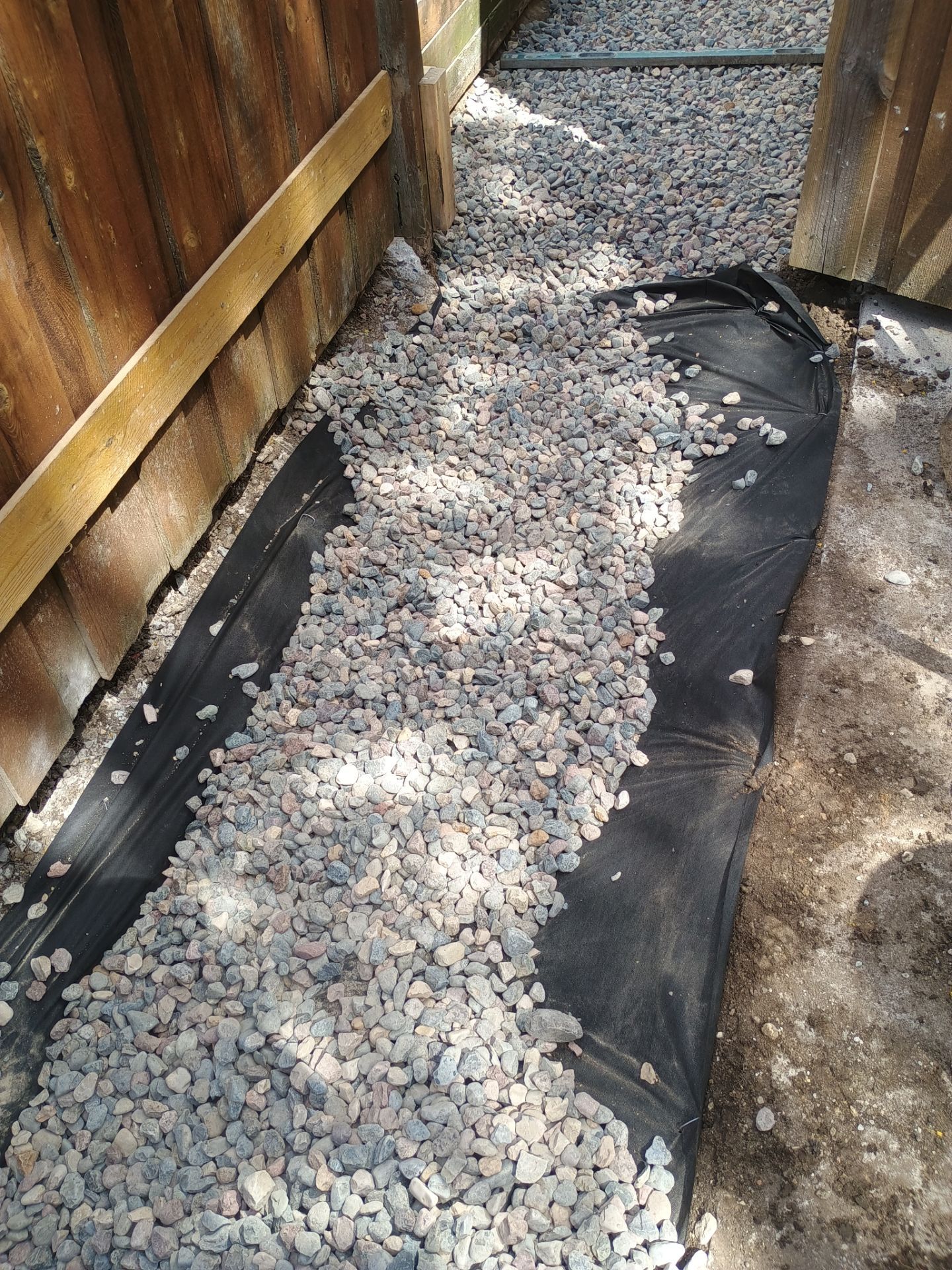
- Aggregate: washed 3/4″ drainage rock. Not pea gravel (clogs), not concrete chips (silts), not whatever was on the truck.
- Geotextile wrap. The trench is lined with non-woven geotextile fabric to keep silt out of the gravel envelope while still allowing water through. Without it, the drain silts shut in five years.
- Discharge: to daylight, dry well, or storm system. The far end of the drain has to go somewhere lower than the source. Otherwise you're just relocating the puddle.
Where surface work fits in the bigger picture.
Surface work tends to be the high-leverage opening move when the obvious contributors are at the surface:
- Standing water in the yard after rain that takes more than a day to dissipate
- Visible pooling against the foundation during or shortly after a storm
- Yard slope that runs flat or toward the house
- Downspouts dumping water within a few feet of the foundation
- Basement seepage that's light, intermittent, and clearly correlated with surface events (rain, snowmelt)
An interior drain tile system is usually the better opening move when the signal points below grade:
- Water enters the basement along the cove joint on multiple walls, in multiple seasons, regardless of recent rain
- The water table itself is high (lake-side or sand-plain properties)
- Block-wall basements have efflorescence and visible mortar-joint failure
- The basement floods during rapid spring thaw events even when surface drainage looks correct
Often the right plan is both, sequenced: surface work first, watch it through a wet season, and add an interior system only if the leak persists. The grading and downspout corrections are worth doing on almost any older home regardless, they're obvious contributors and depending on what you want from the space, attending to them can save thousands or extend the time before a full system is necessary. We'll walk through what we see and lay out the options.
What we install.
- •Hand-shaped 2% minimum grade 6 ft out from the foundation
- •Buried 4″ corrugated perforated drain tile in clean rock, daylighted or to a pop-up emitter
- •Laser-leveled French drains at 18–24″ depth, 1–2% slope
- •Washed 3/4″ aggregate in a geotextile fabric envelope
- •Window-well drainage tied into the surface or interior system
- •Lifetime transferable warranty on installed drainage hardware
- •24″ concrete splash blocks that barely clear the backfill zone
- •Pea gravel or unwashed rock that silts up in 5 years
- •Skipping the geotextile fabric to save $200
- •Drains that discharge into a low spot with nowhere to go
- •“Eyeballing” slope instead of laser-leveling
- Hand-shaped grade restoration to 2% minimum slope, 6 feet out from foundation, with topsoil and sod as needed
- Buried 4-inch downspout extensions in rigid PVC, daylighted or piped to an emitter at the property edge
- French drains per the spec above, with documented slope (we use a laser level, not an eyeball) and geotextile wrap on both sides of the aggregate
- Window-well drainage tied into the surface or interior system as needed
Lifetime transferable warranty on installed drainage components. The grading itself doesn't carry a warranty because what you do with your landscaping after we leave is outside our control, but we'll show you how to maintain it.