
IBC, not IRC.
Residential construction follows the International Residential Code (IRC). Commercial construction follows the International Building Code (IBC). Same authoring body, different documents. The IBC applies to anything that doesn't fit the IRC's narrow definition of one- and two-family dwellings.
That means apartment buildings of three or more units, mixed-use, retail, office, warehouse, industrial, hospitality, and healthcare all sit under the IBC. Compared to residential, the IBC tightens a few waterproofing-adjacent items:
- Continuous air barrier across the entire building envelope (IBC C402.5.1)
- Specific vapor retarder classes for exterior walls (IBC 1404.3)
- Documented material data sheets and warranties on submittal
- Third-party inspection on installed waterproofing assemblies
- Performance testing on completed installations in some jurisdictions
None of that applies to a drain tile install in a 1955 rambler. All of it applies to a six-unit apartment building or an office basement. Knowing which spec a project sits under is the first step in pricing it correctly.
The continuous air barrier requirement (IBC C402.5.1).
The IBC requires a continuous air barrier across the entire building envelope, including below-grade walls. Residential code doesn't. The difference matters because air movement carries moisture: warm interior air hitting a cold below-grade wall condenses into liquid water on the wall surface, even when no groundwater is present.
On commercial work, the below-grade waterproofing has to integrate with the building's overall air barrier strategy. The membrane on the below-grade wall has to tie into the air barrier on the above-grade wall, with documented transitions at the grade line, around penetrations, and at structural breaks. A residential-style spray-on dampproofing won't meet that requirement.
Two different specs. Two different jobs.
| Damp-proofing | Waterproofing | |
|---|---|---|
| Resists | Moisture migration only | Liquid water under hydrostatic pressure |
| Material | Bituminous spray-on coating | Rubberized asphalt, modified bitumen, EPDM, polyurethane, or bentonite panels |
| Seam treatment | Not specified | Documented seams, laps, and penetration details |
| Required when | Low water table, good drainage | High water table, poor drainage, or unfavorable topography |
| Typical failure timeline | 5–15 yr in adverse conditions | 25–50 yr with proper assembly |
IBC 1805 makes a clean distinction between damp-proofing and waterproofing:
- Damp-proofing resists moisture migration but not liquid water under pressure. A bituminous spray-on coating qualifies. Appropriate for sites with low water tables and good natural drainage.
- Waterproofing resists liquid water under hydrostatic pressure. Uses a specified membrane assembly, rubberized asphalt, modified bitumen, EPDM, polyurethane, or bentonite clay panels, with documented seam treatment and drainage media.
The code calls for waterproofing (not damp-proofing) on sites with high water table conditions, soil that doesn't carry water away, or specific topographic factors. Matching the spec to the actual site conditions is most of the job, and the place where shortcuts on a commercial site tend to show up two or three years later.
More square footage, more complexity, more documentation.
Commercial projects spec tighter materials, more durable assemblies, and better documentation because the cost of doing it twice is much higher.
A residential basement leak ruins drywall and a weekend. A commercial basement leak interacts with tenants, mechanical equipment, IT infrastructure, and continuous building operations. The engineering response scales accordingly:
- Larger catchment areas require footing drains and pumping sized for the actual flow volume, not rule-of-thumb residential sizing.
- Occupied spaces below grade, server rooms, mechanical rooms, tenant storage, raise the cost of moisture problems significantly.
- Multiple stakeholders, building owner, architect, GC, mechanical contractor, property manager, tenants, require clearer documentation and coordination than residential work.
- Inspection regimes built around continuous occupancy and code compliance, not single-day residential walkthroughs.
Commercial projects spec tighter materials, more durable assemblies, and better documentation because the cost of doing it twice is much higher. That's the design principle behind every IBC requirement on this page.
What changes when you go commercial.
- Membrane. A true waterproofing membrane replaces residential dampproofing, rubberized asphalt sheet, modified bitumen, polyurethane coating, or bentonite clay panels, with documented seam treatment and proper laps at penetrations.
- Drainage board. Dimpled HDPE drainage board over the membrane, both protecting the membrane and creating a positive drainage pathway down to the footing drain. Standard on most commercial below-grade walls.
- Footing drains. Perforated PVC, gravel envelope, geotextile wrap, daylight or sump discharge, sized for the building's actual catchment area.
- Pumping. Commercial-grade duplex sump systems with alternating pumps (each runs every other cycle so neither sees double the wear), high-water alarms tied into building automation, and standby power.
- Documentation. Manufacturer's installation certificate, third-party inspector sign-off, materials data sheets archived for the building's file.
What we do (and what we don't).
What we do
- Sump pump replacement and maintenance contracts. Property managers and building owners with multi-pump installations get scheduled inspection, replacement before failure, and on-call response when something fails after hours. Cheaper than the basement flood.
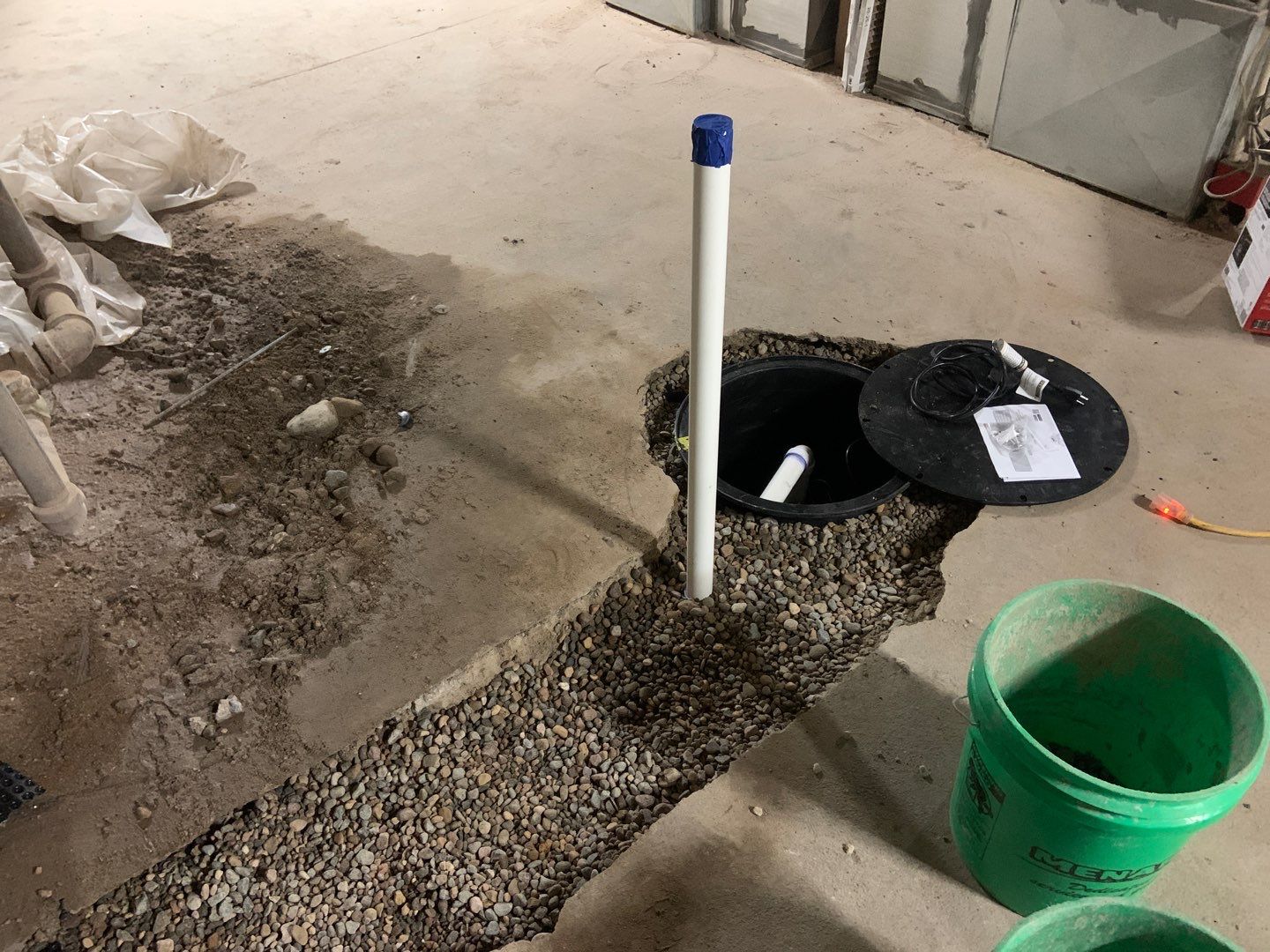
- Interior drain tile and sump pump systems. Below-slab perimeter drainage for commercial basements, sized for the building's actual catchment area. Same engineering as residential interior drain tile, scaled up for the loads and duplex pump assemblies required on occupied below-grade space.
- Elevator pit waterproofing. Interior membrane and crystalline waterproofing for elevator pits, common in older multi-family buildings where the pit takes on water from the surrounding soil and the elevator company won't service it until the pit is dry.
What we don't do
- Large-scale exterior excavation and exterior membrane work. If your building needs the perimeter dug up and a new exterior membrane assembly applied, that's a different specialty. Happy to help scope the job and point you at the right Twin Cities contractor.
- Roofs and any above-grade waterproofing. Wall membranes, balcony waterproofing, deck membranes, call a commercial roofing contractor.
- Plaza decks, vegetated roofs, parking decks, anything horizontal at or above grade. Specialty work that needs a specialty contractor.
The rule is simple: everything we will do is below grade.Interior systems in existing buildings, elevator pit waterproofing, sump pump work. If the question is about a wall above the slab or a roof or deck, we'll point you to the right specialist, usually faster than calling around yourself.
For property managers handling water issues in occupied multi-family buildings, the remediation work we do is planned around tenant access, noise restrictions, and the need to keep mechanical service running through the install.