


The mills that built the city.
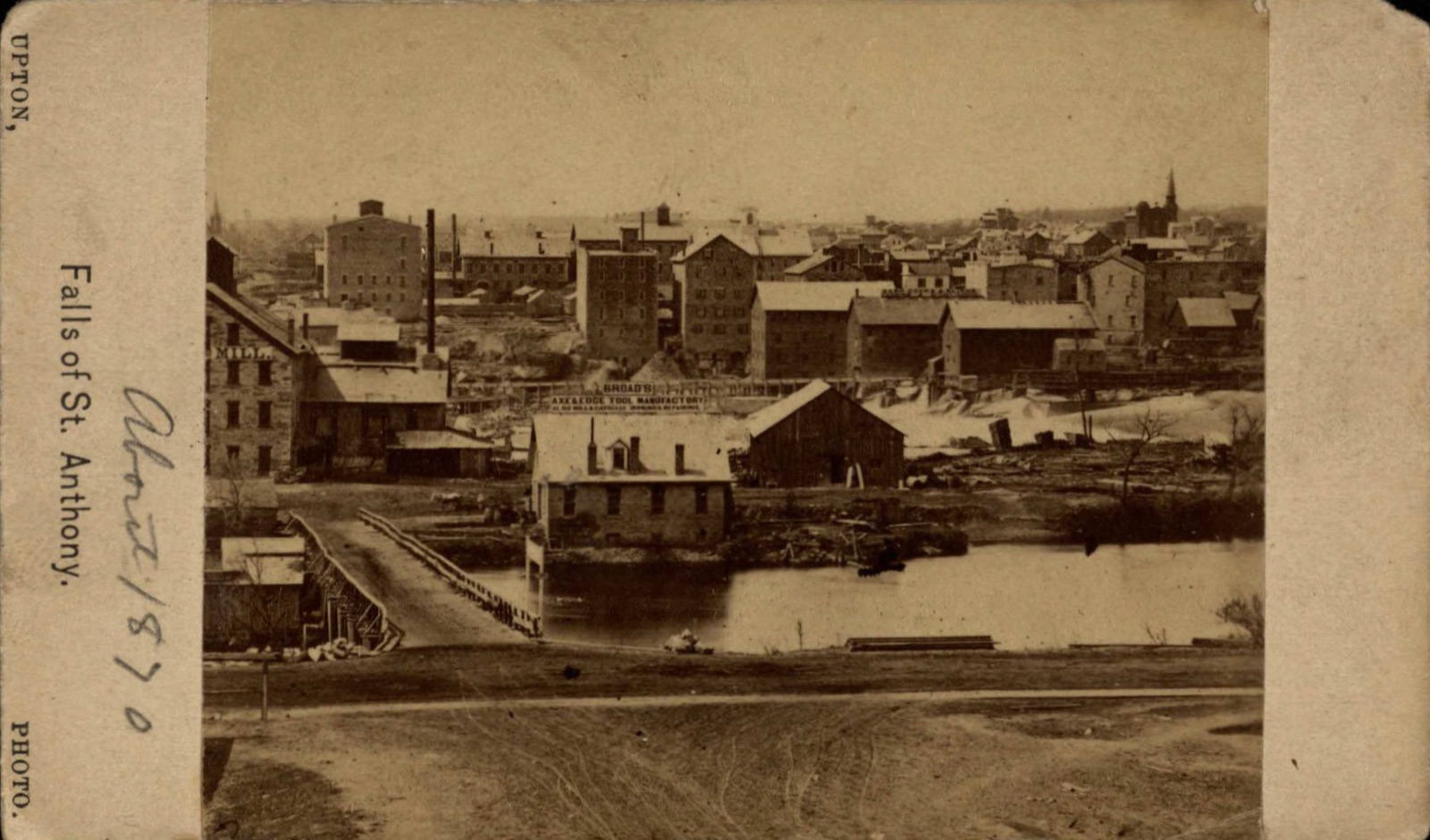
Minneapolis was authorized as a town on the west bank of the Mississippi in 1856 and merged with St. Anthony in 1872. The story of the early city is the story of one waterfall, Saint Anthony Falls, the only major waterfall on the Mississippi River. Hydropower at the falls drove a lumber-milling boom that gave way to the flour-milling era, earning the city the title of “Flour Milling Capital of the World” from 1880 to 1930.
The basements of that era reflect the materials at hand. Foundations were laid in fieldstone and quarried Platteville limestone from the river bluffs, stacked into gravity walls and bound with soft lime mortar. They weren't engineered to keep water out, they were engineered to weep. Builders expected moisture to migrate slowly through the wall, and the open mortar joints gave it somewhere to go.
Streetcars carried people away from the river, and into the bungalow belt.
Public transit started with horse-drawn streetcars in 1875 and shifted to electric trolleys in 1889 under the Twin City Rapid Transit Company. By 1920 the system carried 238 million riders a year. Residents left the grimy industrial riverfront for the streetcar suburbs of South Minneapolis, long blocks of bungalows, four-squares, and craftsman homes built between the 1890s and the late 1920s. By the early 1900s the grid had pushed out into St. Louis Park, Richfield, and Robbinsdale.
These streetcar-belt homes are the limestone-and-brick veterans of the city. Their foundations are stone or early concrete block, with mortar that has been freezing and thawing for over a hundred winters. Every cold cycle pulls the wall apart a little more. The hardest part isn't finding their leaks, it's undoing the well-meaning renovations of the last forty years. When a 1920s bungalow gets a finished basement, sealed walls, and a vapor barrier installed against masonry that was built to breathe, the moisture has nowhere to go. It stays in the wall, in the framing, in the air, and eventually in your shoes.
South Minneapolis was engineered on top of drained lakes.
Before development, much of South Minneapolis was a wetland ecosystem of interconnected shallow “kettle” lakes and peat bogs left behind by the retreating Wisconsin glacier. The city didn't build around it, the city buried it.
- Lake Nokomis (formerly Lake Amelia) was dredged between 1914 and 1918. The city pulled 2.5 million cubic yards of wetland and peat soil out of it. That excavated material was then used to fill 100 acres of adjacent low-lying wetlands so they could be sold as residential lots. The houses in West Nokomis and along Nokomis Parkway sit directly on top of those buried peat soils.
- Lake Hiawatha (originally Rice Lake) was a swampy body of water dredged into a defined park lake.
- The northern arm of Powderhorn Park was filled in during the 1920s.
- Sandy Lake in Northeast Minneapolis was completely drained in 1915, erased from the map, when storm sewers were installed to route the water to the river.
Peat is the worst possible thing to put a house on. It compresses unevenly under load. It holds water like a sponge. When it dries out it shrinks. When it gets wet it expands. Houses built over filled peat, and there are thousands of them across Nokomis, Hiawatha, Field, Regina, and the Longfellow neighborhoods, settle and crack on a schedule the original builder never imagined. The cinder-block foundations of the 1940s and 50s built on this fill are some of the most consistent water-intrusion calls our crew runs.
Northeast sits on a completely different city.
Cross the river into Northeast Minneapolis and you're no longer on the same geology. Northeast sits on the Anoka Sand Plain, a broad, flat outwash plain laid down by the Grantsburg sublobe of the Des Moines Lobe as the Laurentide Ice Sheet retreated 12,000 to 14,000 years ago. The upper soil horizon here is 70–90% quartz sand with very low clay content.
That sandy ground is why Northeast looks the way it does. There were no natural lakes to build around, so the neighborhood was laid out in a strict, efficient grid. It became the natural home of rail yards, breweries, and immigrant worker housing. When Logan Park was acquired in 1883, landscape architects had to add an artificial fountain because the site had no natural water features at all.
Sand looks great until it rains hard. Sandy outwash drains beautifully in a dry season, and acts like a freeway for groundwater in a wet one. Water moves fast through this ground. When a 1950s cinder-block basement in Northeast meets a saturated sand layer, hydrostatic pressure builds at the wall in hours, not days, and the mortar joints between the blocks are the path of least resistance.
The post-war rambler wave.
After the war, the GI Bill turned five million veterans into prospective homeowners. Construction had been frozen for years. Demand was overwhelming. The answer was the rambler, a one or one-and-a-half-story tract home built on a small lot, identical to its neighbors, designed for speed. In the village of St. Louis Park alone, 1,122 building permits were issued in 1950, the third-most of any municipality in Minnesota. Sixty-six new subdivisions and 2,700 new homes went up there between 1950 and 1956.
The post-war rambler is the most common foundation we work on in greater Minneapolis. They were almost universally built on concrete masonry units, cinder block, because CMU was cheap, fast, and didn't require the formwork of poured concrete. Block walls offer moderate water resistance when new. They are highly vulnerable at the seams. Every mortar joint is a potential entry point, and a typical 8-foot basement wall has hundreds of them.
The bigger problem is what these homes didn't have. Drain tile was rarely installed at the footing. Exterior dampproofing was often a single thin tar coat applied by a guy with a brush. Grading was set to whatever the bulldozer left behind. Sixty years later, with downspouts that have shifted, gutters that drop water at the foundation, and a winter cycle that lifts and drops the wall by a fraction of an inch every year, the seepage starts in the cove joint where the wall meets the slab, and almost never stops on its own.
Why Minneapolis basements leak today.
A Minneapolis basement leak is almost always one of three stories:
- Streetcar-belt limestone or brick (1890–1930): mortar that has been freeze-thawing for a century, plus modern interior finishes that trap moisture against masonry built to breathe.
- Cinder-block rambler over peat (1940s–50s South Minneapolis): a wall with hundreds of mortar joints sitting on filled wetland that holds water like a sponge.
- Cinder-block rambler over sand (1950s Northeast and outer suburbs): the same wall sitting on outwash that transmits groundwater fast and pressurizes the foundation in a single heavy rain.
Layered on top of all three: a Hennepin County water table that fluctuates 20 to 30 feet between spring and early fall as municipal pumping draws down deep aquifers and surface impervious cover stops natural recharge. Add chloride-contaminated runoff from winter road salt and you get groundwater that is both more aggressive and more variable than the original builders ever planned for.
What this means for your home.
There is no single answer that fixes a Minneapolis basement, because there is no single Minneapolis basement. The right system for a 1920s limestone foundation in Longfellow is not the right system for a 1955 block rambler in Nokomis or in Northeast. We diagnose first. We tell you what era your foundation is, what it's sitting on, and what specifically is failing before we quote a system.
We also tell you what notto do. If your gutters and grading aren't handling surface water at the foundation, an interior drain tile system is treating a symptom. Sometimes the right call is a grading correction and a downspout extension first, and a $15,000 interior system never. That advice will never come from a salesperson on commission. It comes from us because our reputation in this city is older than most of these basements.
Minneapolis's housing stock is one of the most architecturally important in the upper Midwest. Bungalows, four-squares, mid-century ramblers, every one of them is a record of a moment in the city's growth. Keeping them dry isn't just keeping your basement dry. It's preserving the structural health of the houses that built the city. We take that seriously.