

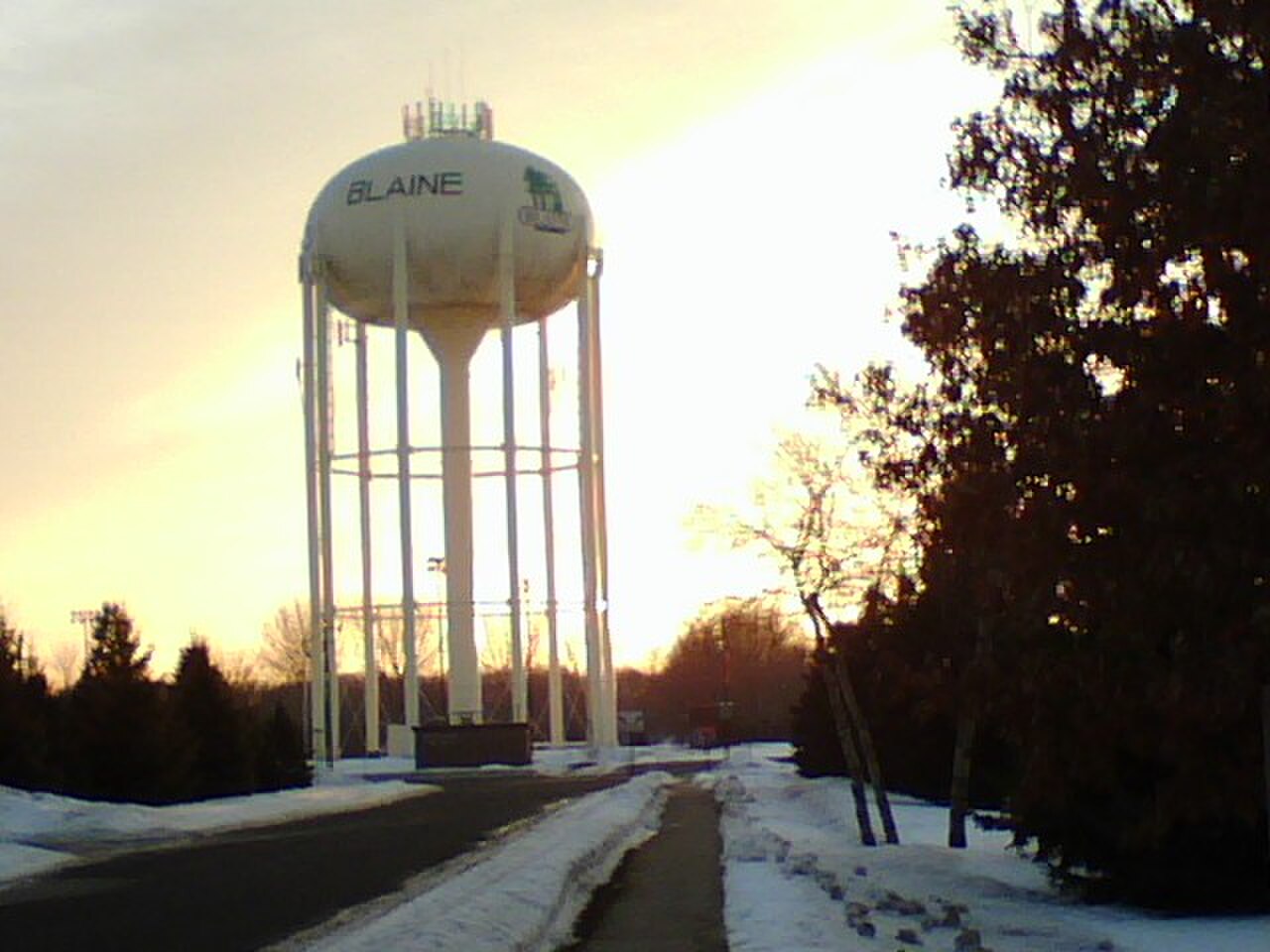
The township nobody could farm.
Blaine separated from Anoka in 1877 and organized as its own township. Moses Ripley, a transplant from Maine, was elected the first board chair, and he persuaded his fellow supervisors to name the new township in honor of James G. Blaine, a U.S. senator and statesman, also from Maine. The first government survey of the area, run by Deputy Surveyor Andrew Hewett in 1847, had been completed “by slogging through swamp and thicket and over dunes.” That description was a warning.
While the rest of Anoka County was being plowed under for sod farms and vegetable crops, Blaine sat largely untouched. Its sandy soil and abundant wetlands discouraged farmers entirely. It remained a prime hunting area when the surrounding towns were already grids. In 1880 the population was 128 people. By 1950, after 73 years as an incorporated township, it had only grown to 1,694. That is one of the slowest growth curves of any city WPNE services. The ground itself was the reason.
Twenty-five feet of peat under the city.
Blaine sits on the Anoka Sand Plain, the same broad glacial outwash plain that runs north from the Twin Cities to St. Cloud. The plain was laid down about 12,000 years ago by meltwater from the Grantsburg sublobe of the Des Moines Lobe. Sandy upland soils dominate the surface across most of the city: fine to medium quartz sand, 70–90% sand in the upper horizons, very low clay content, drains fast in dry season and pressurizes fast in wet season.
What makes Blaine different from every other city on the Anoka Sand Plain is what fills its low spots. Across the township, ice-block depressions left by the retreating glacier filled with cold standing water for thousands of years. Slowly, the dead plant material accumulated. Peat, in undisturbed conditions, builds at less than a millimeter per year. In parts of the Blaine Wetland Sanctuary, that buildup has produced peat 25 feet deep. That is not a typo. There are places in Blaine where the organic soil under your feet started forming when mammoths still walked Minnesota.
Peat is the worst possible foundation soil. It holds water like a sponge. It compresses unevenly under structural load. It shrinks when it dries and expands when it wets. Anywhere a Blaine home was built over a filled or partially-filled peat pocket, and there are thousands of them across the city, the basement is going to tell that story eventually.
The post-war starter home wave.
The first time Blaine grew significantly was after World War II. The housing shortage that followed the war was severe, and developers who had been pushed out of Minneapolis and the older suburbs needed land that was cheap. Blaine was cheap. The wet, sandy ground that had kept the township at 1,694 people for seventy years became a feature instead of a bug for developers building starter homes, small, single-story or 1.5-story homes priced for veterans on the GI Bill.
Most of southern and eastern Blaine's oldest residential blocks come from this wave. The foundations are predominantly cinder block, concrete masonry units, stacked and mortared, which was the standard for fast tract construction in the late 1940s and through the 1950s. A few are poured concrete, but block dominates. These homes were built with the drainage systems of their era: a single perimeter drain tile at the footing, a thin tar coat as exterior dampproofing, and grading that the bulldozer left in whatever shape the bulldozer left it. None of that was designed to hold up to seventy more years on top of saturated peat.
Those starter homes are now some of the most consistent water-intrusion calls our crew runs in Anoka County. They have all the failure conditions stacked: cinder block walls with hundreds of mortar joints, drain tile that has silted up over half a century, ground that compresses unevenly under the slab, and a shallow sand-plain water table that rises hard every spring.
Highways and the fastest-building city in the metro.
The construction of Interstate 35W, Highway 10, and Highway 65 transformed Blaine. Suddenly the city was a 25-minute commute from downtown Minneapolis. The wet ground that had been a deal-breaker for farmers and a complication for postwar developers was tolerable for suburban families who didn't care what the soil did six feet below their kitchen, as long as they got a garage. For a string of years, Blaine led the entire Twin Cities metro region in new home construction. The 2020 census recorded 70,222 residents.
The homes that went up from the 1980s onward are mostly modern poured-concrete foundations, a structural upgrade over the cinder-block starter homes of the 1950s, with no mortar joints and no hollow cells for water to collect in. That's the good news. The bad news is that the same builders that put modern walls on these homes did not always do anything different with the ground underneath them. The original peat pockets were still there. The original wetlands had been drained, but draining a wetland is not the same as fixing a wetland. The water table was still where the water table had always been.
Rice Creek, Coon Creek, and where the water actually goes.
Most of Blaine lies inside the Rice Creek Watershed. The northwestern edge of the city drains into the Coon Creek Watershed. Rice Creek eventually flows to the Mississippi River. That sounds like a tidy plumbing diagram, but watersheds in the Anoka Sand Plain don't work the way they do on clay soils. The sand transmits water vertically as much as horizontally. A heavy May rain doesn't just flow toward the creek, it sinks straight down, hits the shallow water table, and pressurizes every basement on the way.
In undisturbed conditions, the wetlands of Blaine were the storage tank that absorbed those events. When you drain the wetlands and pave over the recharge surface and pack in 70,000 people, the storage tank gets smaller and smaller. The water still arrives. It just arrives in basements instead of in marshes.
Why Blaine basements leak today.
A Blaine basement leak is almost always one of two stories:
- The 1950s starter home on cinder block over filled wetland. Southern and eastern Blaine is full of these. The wall has hundreds of failing mortar joints. The drain tile is silted. The peat under the slab has compressed three quarters of an inch in seventy years. Surface grading has shifted with every owner. When the spring water table arrives, it has half a dozen paths into the basement to choose from.
- The 1990s or 2000s poured-concrete home on a drained peat pocket. The wall is fine. The dirt underneath is the weak link. As the peat pocket settles unevenly, hairline cracks open at the cove joint or at lateral seams. Modern drain tile keeps up for the first decade or two, then silts up. The first serious leak usually announces itself fifteen to twenty-five years after the certificate of occupancy.
Layered on top of both stories: a sand-plain water table that recharges 4 to 8 inches a year, the highest in the region, and the ongoing loss of natural wetland storage as Blaine continues to develop. The water hasn't changed. What used to absorb it has.
What this means for your home.
Blaine has two distinct waterproofing populations, and they need two very different conversations. The 1950s starter homes are at the point in their lifecycle where the original drainage system is fully expended. For most of those homes, an interior drain tile system with a modern sump and a vapor management plan is the honest answer. We'll quote that work directly, and we'll tell you what it costs, and we'll back it with our lifetime transferable warranty.
The 1990s and 2000s homes are a different conversation. Most of them don'tneed a full interior system, at least not yet. The high-leverage opening move is usually a sump replacement, a grading and downspout correction, and a flush of the existing tile. Those are obvious contributors worth investigating first, addressing them often keeps the basement dry for another fifteen or twenty years, and depending on your goals for the space, can save thousands. We'll tell you when it's that. We'll also tell you when it isn't, when the peat pocket under your slab has compressed enough that the original drain tile is below the slab and useless, and anything smaller would be a waste of your money.
Blaine's housing stock is unusual. A 1950s rambler on cinder block and a 2005 colonial on poured concrete might sit on the same block, draining into the same kettle pocket, with completely different right answers. We diagnose first. That's what we're known for in Anoka County, and it's the only reason we'll still be on your block in ten years.