

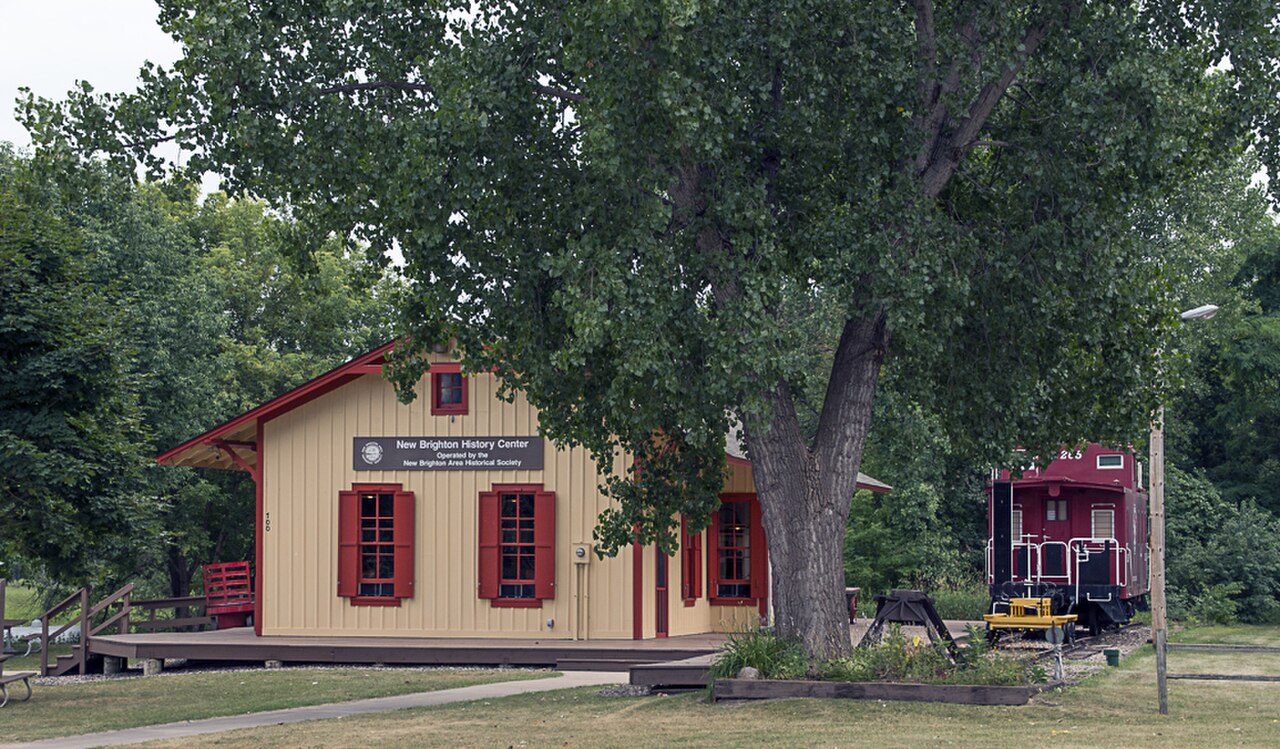
From Brighton, England to Mounds View Township.
The first settler in what would become New Brighton was Charles Perry, who bought 89 acres of land by Lake Johanna in 1849. By 1858 the area was organized as part of Mounds View Township. The settlement of British and French immigrants that grew at the township's center was simply named “Brighton,” after the English city most of the early residents had left behind. The original Brighton had a general store, a school, and a mission church, and not much else for the next thirty years.
The 1888 stockyards and Long Lake.
What put New Brighton on the map was meat. In 1888, Minneapolis millers and businessmen formed the Minneapolis Stockyards and Packing Company. They picked a site on Long Lake and started building. The Minnesota Transfer Railroad Company arranged the rail connections needed to receive and ship livestock, and within a year the stockyards were operating at scale.
In 1889 the surrounding town was formally organized. On January 20, 1891, the Village of New Brighton incorporated, the name had picked up the “New” to distinguish it from the older Brighton settlement nearby. For the next several decades, this was a railroad and stockyards town. The annual Stockyard Days festival still survives as a civic ritual. The worker housing built to support all of that, small wood-frame homes on stone or early-block foundations, still survives too.
Ramsey County glacial till.
New Brighton sits on glacial till, the unsorted mix of clay, silt, sand, and gravel left by the retreating Wisconsin glacier. The clay content of the till holds water against foundations, and the embedded sand and gravel pockets transmit it unpredictably. The clay-bowl effect, where loose backfill around a foundation traps water against the wall, is the most common failure mode in New Brighton basements.
Long Lake, Lake Johanna, and the smaller lakes through the city add a perched water table along their shorelines that comes up to slab elevation every spring. The original stockyard worker housing was built near these water bodies because that was where the rail and water access was. A century-plus later, that proximity is exactly the waterproofing challenge those homes face today.
The worker bungalow era.
The homes that went up around the New Brighton stockyards between 1890 and 1940 were small bungalows, four-squares, and craftsman houses on fieldstone, brick, and early concrete block foundations. They were built before modern drainage existed and were designed assuming moisture would migrate slowly through the wall and out. After a century of freeze-thaw and a hundred Minnesota winters, the mortar has crumbled out of the joints and the wall has stopped doing its slow weeping gracefully.
Highway 65, I-694, and the post-war suburb.
After World War II, New Brighton transitioned from a stockyards town into a residential suburb. The construction of Highway 65 (Central Avenue) and later Interstate 694 made the city commutable from both Minneapolis and Saint Paul, and the resulting post-war boom filled in most of the remaining open land. The result is the now-familiar pattern: cinder-block ramblers from the 1950s and 1960s, transitional poured-concrete homes from the 1970s, and modern poured-concrete homes filling in the lots from the 1980s onward. All sitting on the same Ramsey County till as the original stockyard worker housing.
Why New Brighton basements leak today.
A New Brighton leak is usually one of three stories:
- The 1890s–1930s stockyards-era bungalow on stone or early block. Lime mortar crumbling. Perched lake-side water table. Century of freeze-thaw.
- The 1950s–60s cinder-block rambler. Mortar joints failing, original drain tile silted, grading shifted, clay bowl pressurizing the wall.
- The 1980s-and-later poured-concrete home near a lake or low spot. Wall is fine. Perched water table comes up to slab elevation. Cove joint cracks open.
What this means for your home.
For the stockyards-era homes and post-war ramblers, the honest answer is usually a full interior drain tile system with a modern sump. We'll quote that work directly and back it with our lifetime transferable warranty. For newer homes near the lakes, the high-leverage opening move is usually a sump replacement, a downspout and grading correction, and a flush of the existing tile. Those are obvious contributors worth investigating first, addressing them, depending on your goals for the space, can save thousands and extend the time before a full system is necessary. We'll tell you which.