

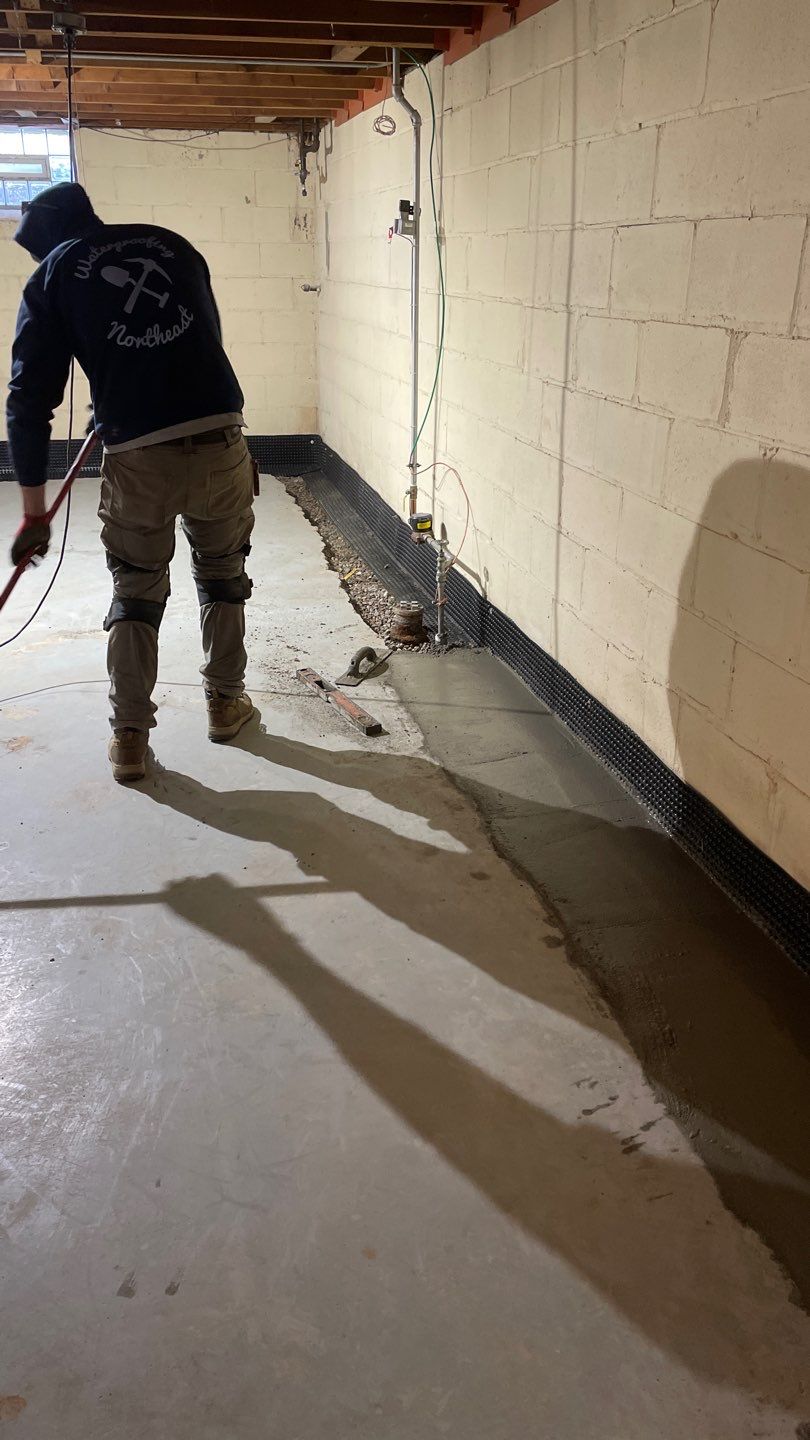
What a top-of-footer system actually is.
Several large national franchise waterproofers built their entire business model on these systems, marketed under brand names like WaterGuard, BasementGutter, BeaverGuard, and various others. The systems consist of a perforated or slotted plastic channel, looks like a long L-shaped trough, installed at the seam between your basement floor and wall. Water enters the channel as it weeps up through the cove joint, gets routed to a sump pit, and pumps out.
The marketing pitch is that these systems are “drain tile.” They aren't. They are a fundamentally different product that solves a different problem, and any waterproofer who claims otherwise is hoping you don't know enough about the physics to ask the right question. For the specific franchise-vs-honest-contractor comparison on this product category, see our dedicated breakdown of WaterGuard vs real drain tile.
The physics problem, it doesn't relieve hydrostatic pressure.
Real interior drain tile works by creating a drawdown curve in the local water table. A 4-inch corrugated perforated pipe sits below your slab at footing depth, in a bed of clean washed gravel. Water in the surrounding soil flows preferentially into the pipe because the pipe is the lowest accessible elevation. As water enters the pipe, the local water table drops in a cone-shaped depression around the perimeter of your foundation. Hydrostatic pressure on the wall and slab drops with it. The wall is no longer the path of least resistance for groundwater. The pipe is.
A top-of-footer channel sits at the same elevation as the slab. It can't create a drawdown curve below the slab. The water table doesn't drop. The pressure doesn't relieve. The water still pushes through your wall, your cove joint, your slab cracks, it just gets caught by the channel after it's already inside.
This isn't a small distinction. The whole reason drain tile works is the drawdown curve. Without it, you have a gutter for your basement, which is useful in some narrow cases (catching wall seepage from minor cracks, managing the small amount of water that gets past a wall membrane) but is not a substitute for actual hydrostatic relief.
Real drain tile vs channel system, same install footprint, different physics.
| Real interior drain tile | Top-of-footer channel system | |
|---|---|---|
| Pipe location | Below slab at footing depth (typically 8-12″ below slab top) | At slab elevation or on top of footing |
| Drawdown curve | Yes, water table drops around foundation | No, water table unchanged |
| Pressure relief | Yes, hydrostatic pressure on wall drops | No, wall sees same pressure as before |
| Catches water when? | Before it reaches the slab | After it breaches the cove joint into your basement |
| Install time | 1-3 days (saw + dig + re-pour) | 1 day (no concrete demo) |
| Slab work | Cut 12-16″ perimeter, re-pour | None, adheres to existing slab |
| Clog risk | Low, gravel envelope + geotextile | Higher, sediment accumulates at slab height |
| Lifetime warranty validity | Yes if installed correctly | Yes but warranties water through the channel, not pressure-driven wall failure |
When a channel system is actually OK.
To be fair, these systems serve a purpose in some specific scenarios. They're not always the wrong call:
If your slab is too thin to safely cut (rare, most slabs handle a 12-inch perimeter cut fine), if you absolutely cannot have construction in your basement for more than a day, or if you genuinely cannot afford the additional cost of a real drain tile install, a channel system is better than nothing. It will catch wall seepage. It will route water to a sump. It will reduce moisture in the basement.
What it won't do is solve hydrostatic pressure problems. If you have water actively pushing through your cove joint because the water table is high or because the clay-bowl effect is pressurizing your wall, a channel system manages the symptom. It does not address the cause.
How to spot a channel system on a quote.
Most homeowners don't realize they're being sold a channel system until after install. The language is intentionally vague. Here's what to look for:
- “Sub-slab drain system”, vague phrasing. Ask: is the pipe physically below the slab, or at slab level?
- “WaterGuard,” “BasementGutter,” “baseboard channel,” or any proprietary product name, these are almost always channel systems.
- “No need to break up your basement floor”, this is the giveaway. Real drain tile requires cutting the slab. If they're selling you something that doesn't involve concrete demo, it's not below-slab.
- Same-day or one-day install, a real drain tile install is 1-3 days. A same-day install means no concrete cutting, which means no below-slab work.
- “Works like a French drain”, false. A French drain is also below-grade. The mechanism is identical to drain tile in that it relieves pressure by creating a drawdown.
When in doubt, ask one question: where is the drain pipe relative to the bottom of the footing?If the answer is “at the top” or “on the slab,” you're being sold a channel. If the answer is “below the slab at footing depth,” you're being sold real drain tile. That single question separates the two products definitively.